The requirements for innovative components require materials with a defined property profile. These depend on the chemical composition and on the microstructure developed during the manufacturing process. Therefore, a better understanding of microstructure development enables the manufacture of components with tailored properties.
In order to use the high-performance computing system as efficiently as possible, highly optimized and vectorized codes of the models, used for the simulation, are developed in the group.
The simulations run on high-performance computers, such as those used at the High-Performance Computing Center Stuttgart (HLRS). The simulations are carried out on tens of thousands of computing units, with the massively parallel solvers Pace3D and waLBerla developed at the institute.
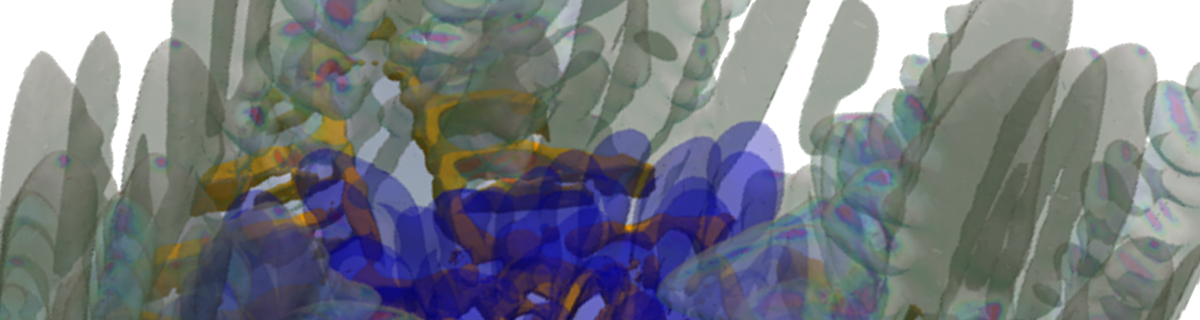
Concerning alloys, the focus of the work is primarily on the development of microstructures through different process parameters, which, for example, occurs during the directional solidification of binary and tenary eutectics, as well as on the coupled eutectic-dendritic growth.
Furthermore, the research group deals with the simulation of solid phase sintering in the initial and medium state as well as the development of microstructures in the final stage of sintering, under the influence of pores.
To generate realistic microstructures, such as microstructures of green bodies with a defined density, particle size distribution and particle shape, and evaluate the large-scale simulation results, for example in the development of fibers during directional solidification, different tools are also developed in the group.