
Development of Advanced Energy Materials and Processes (EMP)
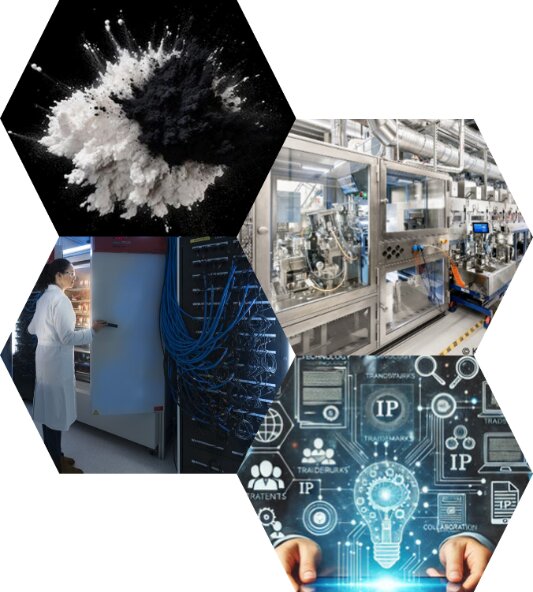
Over the past two decades, significant progress has been made in the development of high-performance energy storage technologies, such as lithium-ion batteries (LIBs). However, to enable the next generation of electric vehicles as well as electric aviation and robotics, significant step-changes on safety, cycle life, energy density, and charging speed will be required. The research group Development of Advanced Energy Materials and Processes (EMP) tackles these challenges by starting where battery innovation begins: with the materials themselves and how they are manufactured. For this approach, the research group has been recognized as the first Helmholtz Innovation Exploration Group at KIT. Its aim is to strengthen Europe’s capabilities in advanced energy materials and manufacturing by integrating supply chain and environmental considerations into material design and production processes. This creates a direct pathway from research to industrial application, supporting the targeted and rapid transfer of technologies into the market.
In close collaboration with industry partners, the research group focuses on four areas: material development and characterization, intelligent process development, all-solid-state battery (ASSB) cell design and testing, as well as manufacturing process scale-up and techno-economic evaluation, aiming to ensure market readiness for spin-off incorporation.
Material development and characterization

Compositionally complex materials (CCMs) that include the so-called high-entropy materials have been identified as promising candidates for a variety of energy applications.1,2 The research group focuses on their use as active material coatings and solid electrolytes for lithium-ion as well as post-lithium battery applications. The key advantage of CCMs rests upon their design flexibility, which allows the functionality of CCMs to be tailored to their intended applications while reducing or even eliminating the use of critical raw materials. Their potential can further be exploited by suitable processing techniques enabling morphological and structural control. Both the design and the processing techniques of CCMs are areas of active research in the group.
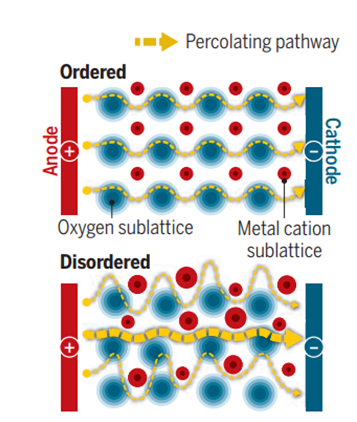
A high ionic conductivity of CCMs is a prerequisite for their cell integration as particle coatings and solid electrolytes. The conductivity can be tailored by changing the energy landscape for ion migration through disorder by design.3 The research group possesses expertise in the electrochemical characterization of compositionally complex ionic conductors in correlation with structural and morphological optimizations through intelligent process development.
Intelligent process development

Processes developed within the research group not only consider material functionality but also take account of environmental and economic factors already at laboratory scale. In this context, a novel photonic-assisted coating technology was developed (patent pending) to eliminate thermal losses and increase processing speed by a factor of 15. In addition, this technology delivers a high coating conformity, enabling the development of ASSBs. The group continues to advance this technology and employs it to coat nickel-rich cathode active materials, for example, facilitating faster charging and prolonged cycle life of state-of-the-art LIBs.4
All-solid-state battery cell design and testing
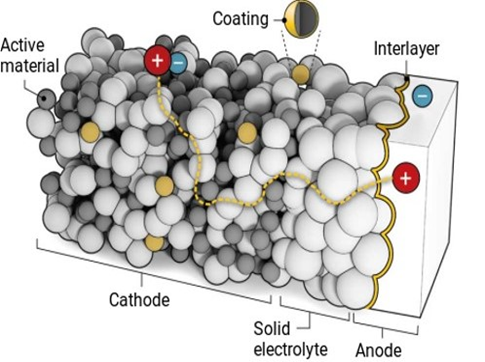
ASSBs promise to provide the high energy density that commercially available lithium-ion batteries are lacking. The bottlenecks impeding their commercialization are the interfaces between active materials and the solid electrolyte. The research group tackles these interface challenges through active material particle coatings as well as electrolyte optimization, providing a concerted cell design.
Scale-up and techno-economic evaluation
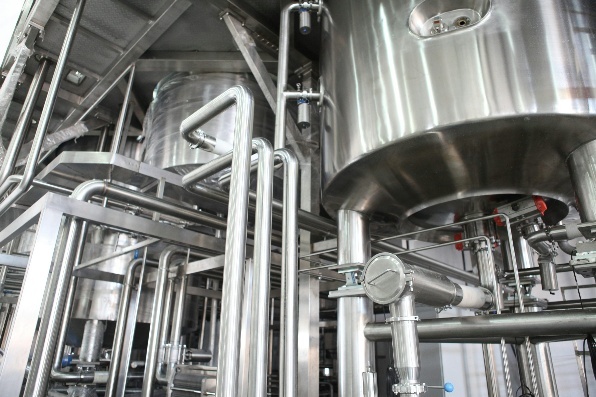
Beyond innovative laboratory-scale research, a core mission of the group is to drive the scale-up of new technologies from gram to kilogram scale, laying the foundation for technology transfer activities. The challenges, therefore, extend beyond materials science into chemical and process engineering, including the design and commissioning of pilot reactors. In addition, each scale-up project is accompanied by a techno-economic evaluation to incorporate relevant commercial perspectives from the start. To benchmark the results against state-of-the-art technologies, the research group actively collaborates with industry partners and research institutes.
References
- Tarancón, A. et al. 2026 Roadmap on compositionally complex and high entropy materials for energy applications. Journal of Physics: Energy 8, 031501 (2026).
- Ma, Y. et al. High-entropy energy materials: challenges and new opportunities. Energy Environ. Sci. 14, 2883–2905 (2021).
- Botros, M. & Janek, J. Embracing disorder in solid-state batteries. Science 378, 1273–1274 (2022).
- Cui, Y. et al. Photonic Synthesis and Coating of High-Entropy Oxide on Layered Ni-Rich Cathode Particles. Small Struct. 5, (2024).
| Name | Title | Phone | |
|---|---|---|---|
| Botros, Miriam | Dr. | +49 721 608 29113 | miriam botros ∂does-not-exist.kit edu |
| 1 additional person visible within KIT only. | |||
