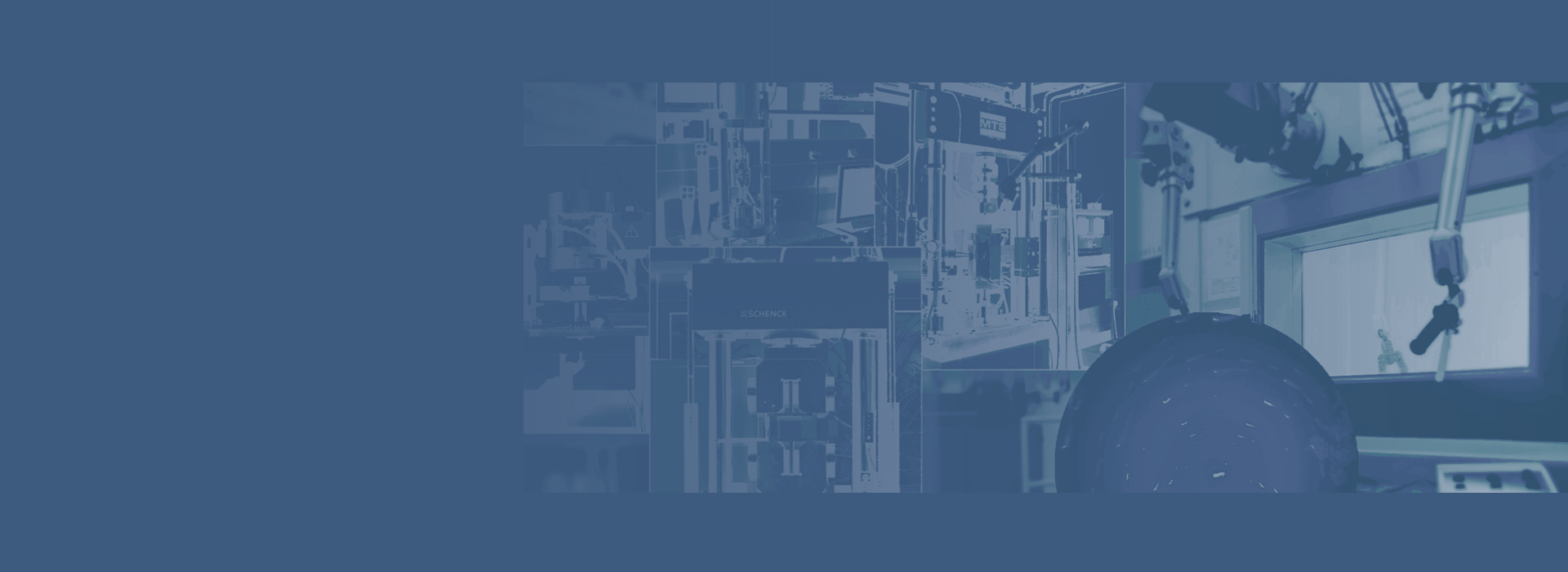
The reliability of such material systems is of major significance for the society concerning functional materials for energy conversion and storage as well as for information technology and requires state-of-the-art mechanical characterization and modelling. Materials of interest span from batteries beyond the Lithium era towards materials for fusion reactors on the one hand, and from advanced conductors to materials for sensors and actuators on the other hand.
We aim for a mechanism-based understanding of material degradation, which requires scale-bridging mechanical as well as microstructural characterization combined with advanced multi-physics modelling and data analysis. We also run KIT´s Fusion materials lab and, therefore, can handle and characterize radioactive and toxic materials.
HeadProf. Dr. mont. Christoph Kirchlechner
Tel.: +49 721 608-24815 |
|
ManagementDr. Johanna Lampert
Tel.: +49 721 608-23754 |
|
|
Administration
Jana Herzog
Tel: +49 721 608-24816 |
|
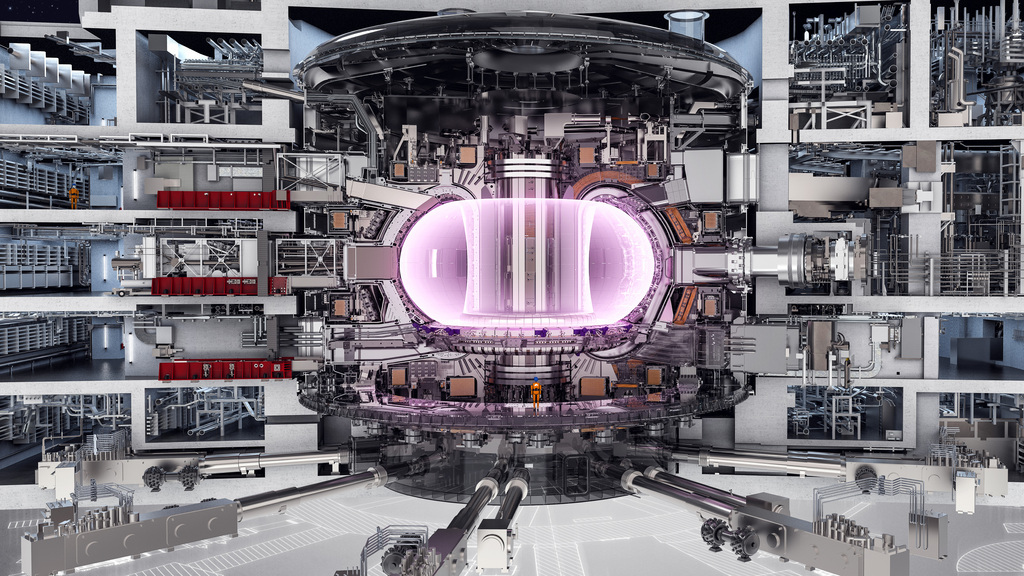
Christoph Kirchlechner played a leading role in the successful application for the Fusion Technology Research Hub in his capacity as spokesperson for the Nuclear Fusion Program at KIT. With the Fusion Materials Laboratory (FML), the IAM-MMI provides a key piece of infrastructure for the hub.
read more
In the article “Fusion: Eine Materialfrage! Plasmaphysik ermöglicht die Fusion – Materialwissenschaft macht sie nutzbar" (Fusion: A Matter of Materials! Plasma Physics Enables Fusion — Materials Science
Makes It Usable) in the journal “Forschung und Lehre” (July 2026), Christoph Kirchlechner describes the challenges that fusion research poses for materials scientists.

Ashwini Kumar Mishra's and Jarir Aktaa's research article Phased Array Ultrasonic Testing of W/EUROFER Functionally Graded Coating was recognized as “Editor's Choice Article” by the journal “Materials”. The work focuses on the analysis of coating/substrate interface characteristics and detecting delamination using a phased array ultrasonic testing method.
We congratulate them on their article’s recognition.

UC Santa Barbara materials professor Daniel Gianola was awarded the Friedrich Wilhelm Bessel Research Award from the Alexander von Humboldt Foundation and the International Excellence Fellowship given by KIT. He also received the 2026 Brimacombe Medal from The Minerals, Metals & Materials Society (TMS). As part of these awards, he will spend a research year at the IAM beginning in July 2026.
Welcome back!

Xufei Fang has been awarded the 2026 Ross Coffin Purdy Award from the American Ceramic Society (ACerS). This award shall be given to the most valuable contribution to ceramic technical literature published two years prior to the selection year. Dr. Fang’s award-winning paper presented a new perspective of mechanics-guided tailoring of dislocations in ceramics at room temperature for engineering advanced ceramics. He is invited to the ACerS annual meeting in Pittsburgh, USA, to receive the certificate and the Ross Coffin Purdy medallion.
Congratulations, Xufei!
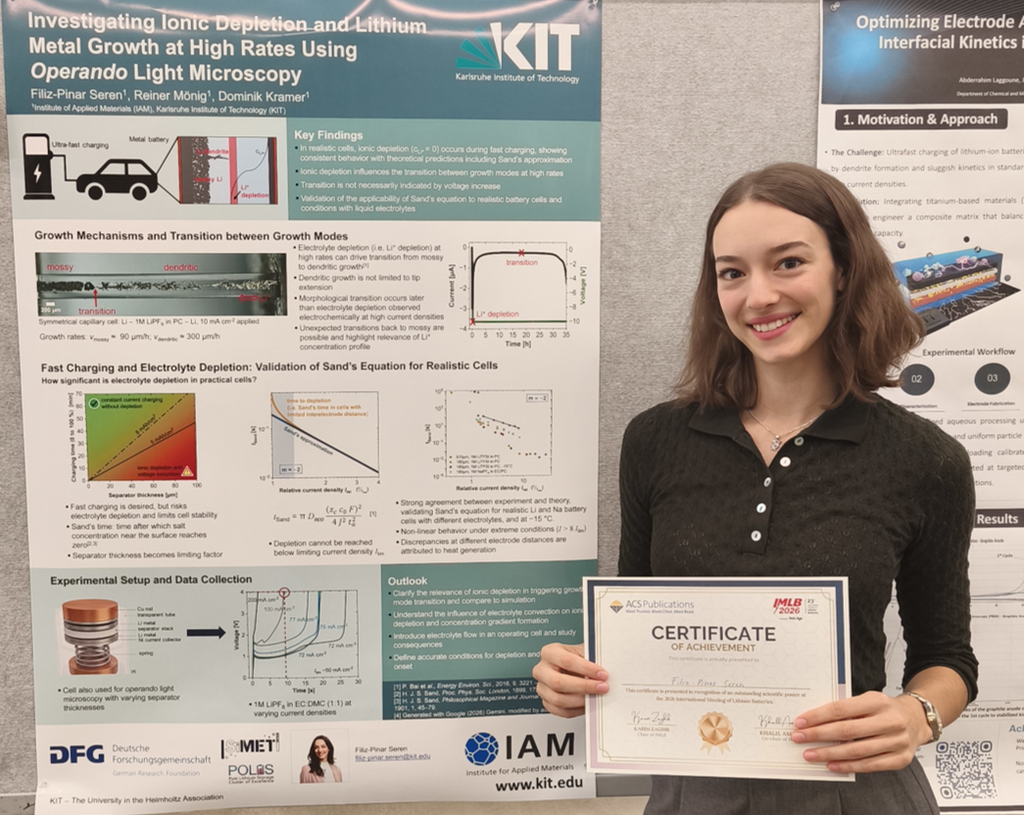
Filiz-Pinar Seren’s research was recognized with an Outstanding Scientific Poster Award at this year's International Meeting on Lithium Batteries (IMLB 2026) in Montréal, Canada. The award-winning poster focuses on the field of metal batteries, specifically shedding light on the critical aspects of fast charging.
We warmly congratulate her on this well-deserved recognition!

The spokesperson for the Fusion Program at KIT, Christoph Kirchlechner, spoke with Gábor Paál (SWR) in a SWR-Wissen podcast: Electricity from nuclear fusion – When will the first power plant be built? (in German only)
To the podcast at SWR-Wissen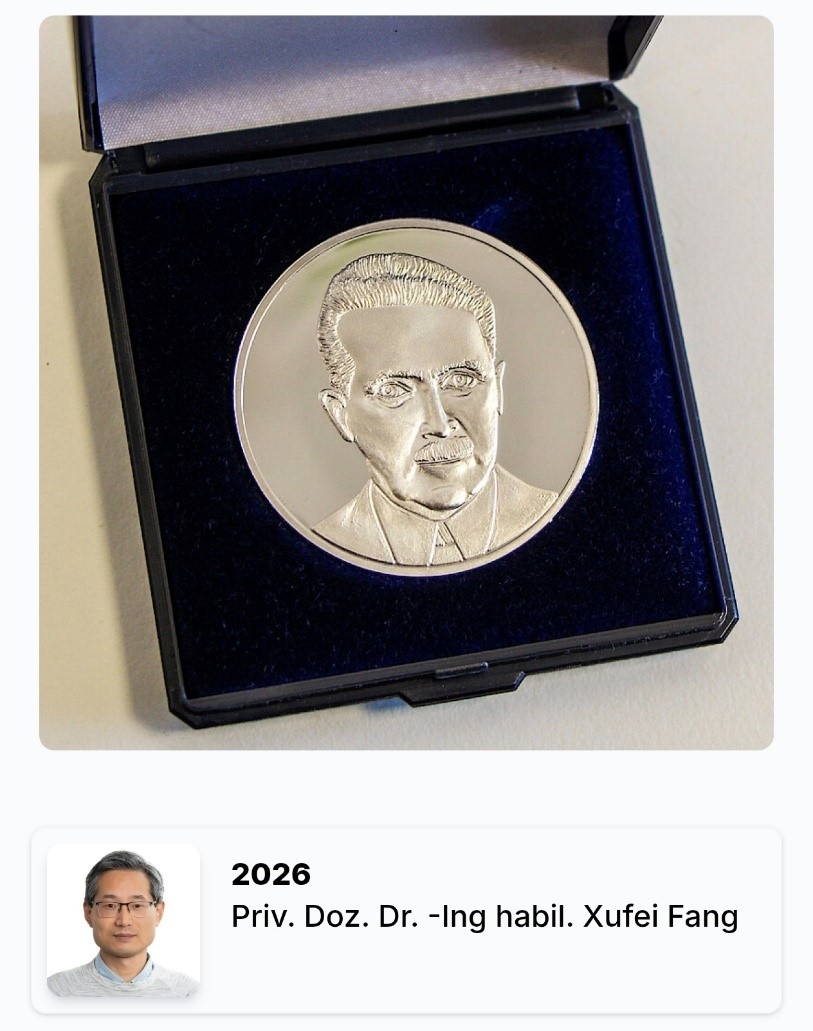
Xufei Fang has been awarded the 2026 Masing Memorial Prize from DGM (German Society for Materials Science), for his independent and pioneering scientific research work on “dislocations in ceramics”. The prize can be awarded only once a year, and is considered the highest achievement for young DGM members with the doctoral disputations less than10 years at the time of nomination. The prize is named after the long-time DGM chairman and honorary chairman Georg Masing.
Congratulations, Xufei!

Yinxia Zhang successfully defended her dissertation “The effect of grain boundaries on the fracture toughness of hard coatings” on 30 March, 2026.
Her work advances our fundamental understanding of grain-boundary mediated fracture processes in hard protective coatings.
Congratulations!
In the BMFTR project KONZEPT, which has been approved for 2 years, scientists from the MEC department of the IAM-MMI, the INR and the ITEP are working on the development of concepts for the first wall and the breeding blanket of future laser fusion power plants. The activities include the integration of the concepts into a power plant system code, taking into account the behavior of the materials selected for this purpose, and the identification of the R&D work required to implement the concepts.
KONZEPT is coordinated by Siemens Energy AG and carried out by 7 partners from research and industry.

Richard Schütz and Cornelius Baumgartner took first place in the field of technology at the Jugend Forscht Regional Competition 2026 in Pforzheim with their "Optimization of 3D printing paths using stress analysis for higher component stability".
The work was created as part of the KIT-Hector Seminar 2025 cooperation at the IAM, where Richard (Heisenberg-Gymnasium Bruchsal) and Cornelius (Gymnasium Neureut, Karlsruhe) invested their spare time in FEM analyses, 3D printing and materials testing.
Congratulations! We would be delighted to see Richard and Cornelius again one day as students at KIT, because young talents with an enthusiasm for technology are in exactly the right place here.
read more at Hochschule Pforzheim
Mathias Jetter successfully defended his dissertation „Probabilistische Charakterisierung und Modellierung des spröden Bruchverhaltens von Wolfram“ on 25 February, 2026. His work deepens our fundamental understanding of brittle fracture and its probabilistic nature — an important step in the development of fast fracture design rules for brittle/embrittled materials. Congratulations!
Find older news in our News Archive