
PoWer
Project manager: M.Sc. Elias Gall
Motivation
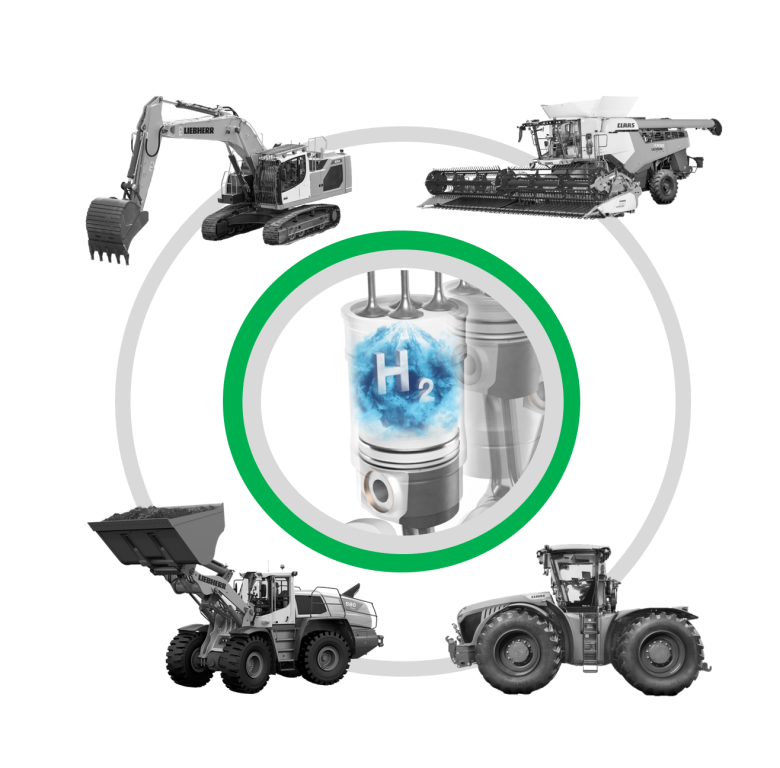
The combustion of fossil fuels in internal combustion engines contributes to human-induced climate change. In order to continue using the internal combustion engine – which has reached a high level of technological maturity – primarily in non-road applications, it can be operated in a climate-neutral manner by burning so-called ‘green hydrogen’ [1]. The series production of such hydrogen-powered internal combustion engines was already achieved several years ago, for example by BMW [2]. However, the design of these engines for operation with hydrogen instead of diesel or petrol is significantly more challenging and has not yet been established [1]. As a very small element, hydrogen can diffuse into the materials and alloys used in the engines, leading to what is known as hydrogen embrittlement, which often manifests itself as an unexpected premature and brittle failure of the affected components [3].
The overarching aim of the project is to analyse the influence of hydrogen on service life and fatigue strength through fatigue testing and by comparing hydrogen-loaded and unloaded samples. Based on this, models for predicting service life under the influence of hydrogen will be developed.
Research questions

-
Do current production materials meet the requirements for cyclic load capacity in hydrogen internal combustion engines?
-
Under what conditions can standardised test methods be developed to assess the fatigue strength of metallic materials in hydrogen-containing environments?
-
To what extent are the effects of electrolytic hydrogen charging and pressurised hydrogen charging – which more closely reflects actual operating conditions – comparable in terms of their impact on metallic materials?
Approach
- Fatigue tests on hydrogen-charged specimens to investigate the influence of hydrogen on service life and fatigue strength
- Comparison of the results with non-charged reference specimens
- Assessment of the comparability of electrolytic charging and pressurised hydrogen charging in terms of their effect on the mechanical behaviour of the materials
- Investigation of material damage using scanning electron microscopy on fracture surfaces and metallographic sections
- Development of models for predicting service life under the influence of hydrogen
Funding
This project is funded by the German Federal Ministry for Economic Affairs and Energy (BMWE). KIT, IAM-WK is part of the consortium.
Literature
[1] K. Wróbel, J. Wróbel, W. Tokarz, J. Lach, K. Podsadni, und A. Czerwiński, „Hydrogen Internal Combustion Engine Vehicles: A Review“, Energies, Bd. 15, Nr. 23, S. 8937, Nov. 2022, doi: 10.3390/en15238937.
[2] W. Enke, M. Gruber, L. Hecht, und B. Staar, „Der bivalente V12-Motor des BMW Hydrogen 7“, MTZ - Mot. Z., Bd. 68, Nr. 6, S. 446–453, Juni 2007, doi: 10.1007/BF03227411.
[3] S. Lynch, „Hydrogen embrittlement phenomena and mechanisms“, Corros. Rev., Bd. 30, Nr. 3–4, S. 105–123, 2012.
[4] J. Wild, „Einfluss von elektrolytischer Wasserstoffbeladung auf die Umlaufbiegewechselfestigkeit des vergüteten Stahls 100Cr6“, Masterarbeit, Karlsruher Institut für Technologie, Karlsruhe, 2021.