
AM StressReduction
Project manager: M.Eng. Jan Lars Riedel
Motivation
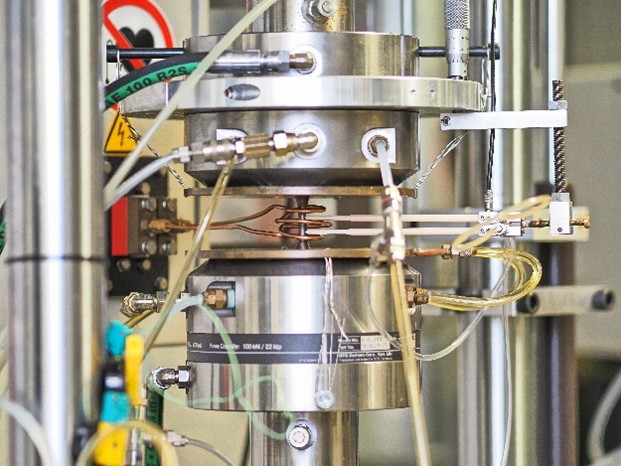
The increasing demands for efficiency, durability and resource efficiency in components that must withstand extreme temperature conditions are driving the growing use of additive manufacturing processes. These modern manufacturing processes not only offer a high degree of design freedom, but also enable the cost-effective production of complex components with bespoke properties. Heat exchangers in particular, which are used in demanding applications such as specialised machinery manufacturing, the chemical industry, power electronics and the aerospace sector, are often subjected to extreme temperature fluctuations. These cyclic temperature stresses lead to thermo-mechanical fatigue (TMF) in the materials, which can significantly reduce the service life of the components.
Conventional materials such as cast and forged steels have undergone extensive development over recent decades. These materials have proven their worth in many applications; however, it is becoming increasingly clear that they do not always meet the requirements of new, innovative designs and more demanding operating conditions. To meet the growing demand for lighter, more powerful and more compact components, there is therefore a growing focus on additively manufactured materials.
However, compared with conventional materials, the thermomechanical properties of additively manufactured materials have not yet been sufficiently researched. Although these materials offer great potential due to their design flexibility and the ability to produce components in almost any shape, there are still significant challenges regarding microstructure optimisation and heat treatment. At present, many components produced using additive manufacturing processes are still often used in their ‘as-built’ state, i.e. without targeted post-processing heat treatment or other forms of optimisation. This approach means that the components do not achieve their optimal mechanical properties, which can, in particular, limit their operational capability and service life.
Project objective
Development of a heat treatment to increase the service life of additively manufactured Inconel 718 and AlMgSi10 under thermomechanical loading.
Investigations
- Metallographic sample preparation
- Heat treatment of the samples
- Scanning electron microscopy characterisation of microstructure using backscattered electron contrast and backscattered electron diffraction
- Phase identification using X-ray diffraction
- Transmission electron microscopy for nanoscale microstructural analysis
Funding
This project is funded under grant reference number KK5039610KL4 by the German Federal Ministry for Economic Affairs and Energy (BMWE).